Adresse
Av du Casino 51
1820 Montreux
Horaire
lundi - vendredi : 09h - 18h
Adresse
Av du Casino 51
1820 Montreux
Horaire
lundi - vendredi : 09h - 18h
Guide · Cosmetic dentistry
What lightening actually does, what it costs, where the kits fall short and when it should be ruled out – without the “eight shades in an hour” promises.
The mechanism
The mechanism is chemical, not mechanical. A gel based on hydrogen peroxide or carbamide peroxide is applied to the enamel. It releases oxygen, which penetrates the micro-porosities of the tooth and breaks down the pigmented molecules accumulated in the dentine. Those smaller, less coloured fragments are what make the tooth look lighter.
The distinction matters: whitening does not remove a layer of tooth, unlike abrasive products. That is precisely why a professional protocol on healthy enamel is considered safe, whereas repeated brushing with baking soda or charcoal wears down dental tissue without changing the internal shade at all.
Budget
Swiss dental fees are calculated in tariff points, which explains the variation between practices. Here are the orders of magnitude seen in French-speaking Switzerland, for guidance.
| Option | Time needed | Indicative fee |
|---|---|---|
| In-practice refresh session | About 30 minutes | from CHF 80 |
| Full in-practice whitening | 60 to 90 minutes | CHF 300 – 600 |
| Custom take-home trays | 10 to 14 days | on quotation |
| Supermarket kit | Variable | CHF 20 – 60 |
Indicative amounts in Swiss francs. The exact price appears on the quotation issued after examination.
No. Swiss compulsory health insurance (LAMal) only covers dental treatment made necessary by serious and unavoidable illness. As whitening is aesthetic, it is paid entirely privately. Some supplementary dental policies do contribute towards aesthetic care: the only way to know is to read your policy or call your insurer before the appointment.
Comparison
Products sold freely in the European Union are capped at 0.1% hydrogen peroxide. Above that, supply goes through an oral-health professional. A supermarket kit therefore mostly acts on surface stains.
A pre-formed tray lets gel escape onto the gums, causing irritation and an uneven result. A tray moulded from your own impressions keeps the product on the teeth, and only on the teeth.
Nobody checks, before you use a kit bought online, that you have no decay, crack or inflamed gum. Applying peroxide to a decayed tooth causes sharp pain and can worsen the lesion.
Expectations
It depends above all on the origin of the discolouration – the point advertising tends to skip.
Coffee, tea, red wine, tobacco. These respond best, and professional cleaning alone is sometimes enough.
Dentine thickens and darkens over the years. Whitening generally gives satisfying, gradual results here.
It does not respond like the others and calls for a different technique, applied from inside the tooth.
The response is unpredictable, and lightening sometimes increases the contrast rather than reducing it.
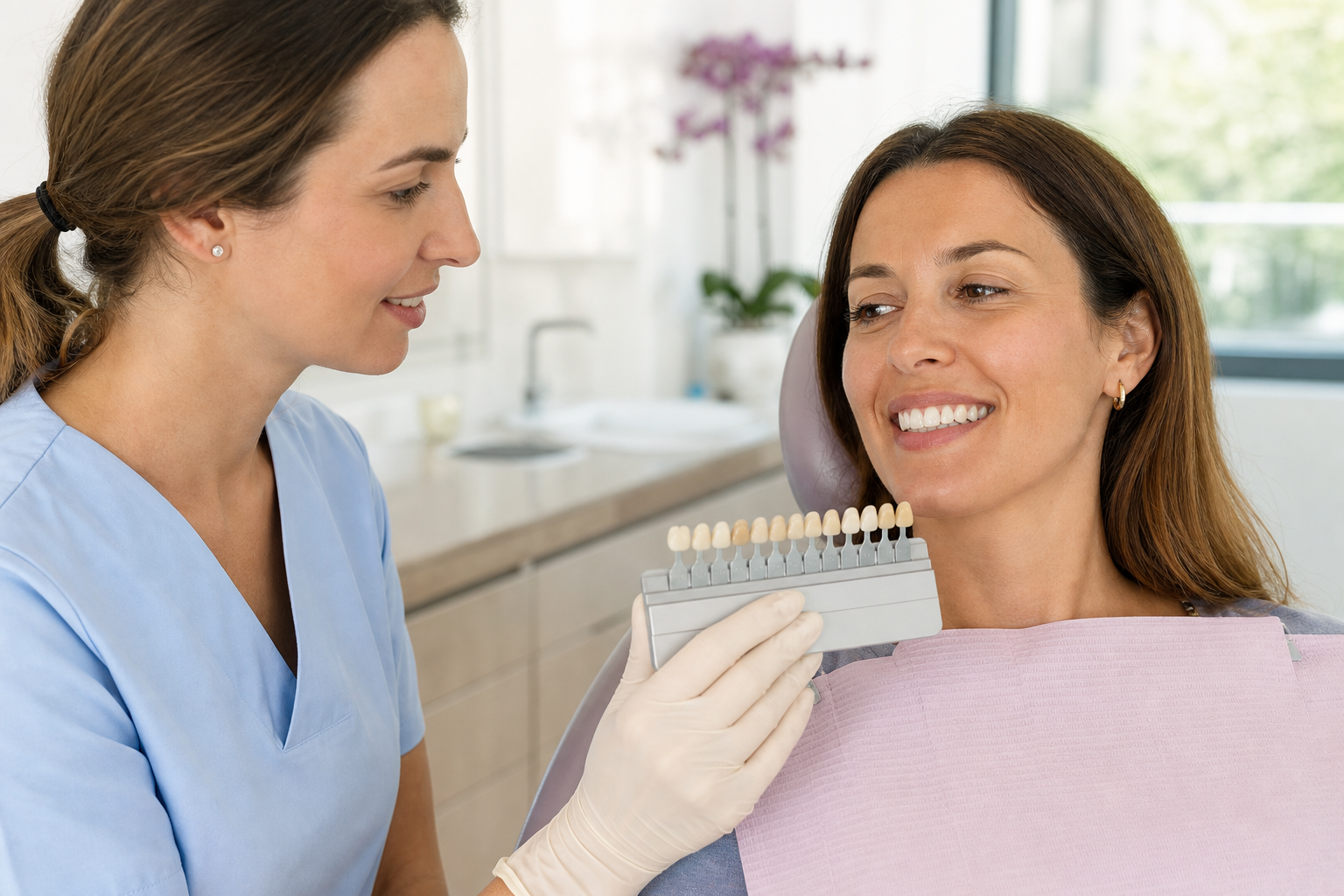
We therefore do not promise a number of shades. What we do is record the shade against a shade guide before and after treatment: that is the only objective comparison, and it concerns your case rather than an advertising average.
Safety
Performed by a professional, after diagnosis, with suitable concentrations and soft-tissue protection, it is not considered damaging to healthy enamel. The most common side effects are transient cold sensitivity and possible gum irritation if the product overflows. Problems arise mainly from repeated unsupervised use of over-the-counter products, abrasive home remedies, and services offered outside a medical setting by people with no dental training.
Durability
No duration can be guaranteed, because the result depends on factors the practice does not control: coffee, tea and red wine consumption, tobacco, brushing quality, starting shade. In practice, a maintained result lasts considerably longer than one left to its own devices.
The first 48 hours deserve particular attention: enamel is temporarily more permeable to pigments, and that is the window in which to avoid strongly coloured food and drink. After that, regular professional cleaning removes the external stains that dull the shade and lets you space out touch-ups.
Making the choice
Many patients ask for whitening when a professional cleaning would meet their expectation. A few pointers:
| Your situation | Most suitable route |
|---|---|
| Coffee or tobacco stains, healthy teeth | Professional cleaning first |
| Natural teeth yellowed evenly | In-practice whitening or custom trays |
| Well-aligned teeth but a dull shade | Whitening |
| Irregular shape, gaps, cracks | Aesthetic assessment, veneers to consider |
| A single dark tooth after root treatment | Internal bleaching technique |
When both whitening and veneers are being considered, the order matters: natural teeth are lightened first, then the veneer shade is chosen to match the result achieved. The reverse means redoing the restorations.
FAQ
The session itself generally is not. Cold sensitivity may appear during or after and usually settles within one to three days. A desensitising toothpaste helps, and the concentration can be reduced if you are sensitive.
No. Ceramic and composite do not react to whitening agents. If a visible restoration ends up too dark against the lightened neighbouring teeth, replacing it can be discussed. This is assessed at the initial check, not after treatment.
Not always. It becomes useful when deposits or external stains prevent a correct shade assessment or an even result. Sometimes cleaning alone is enough to restore a satisfying shade.
They act by abrasion on surface stains and do not change the tooth’s internal shade. Used regularly, they wear down enamel, which lets the underlying dentine show through and paradoxically makes teeth look yellower over time.
Not during treatment with bonded brackets: the areas underneath do not lighten and would leave visible marks on removal. We wait until orthodontic treatment is finished and the gums have settled.
From CHF 80 for a refresh session to roughly CHF 300 to 600 for a full in-practice treatment. Custom take-home trays are quoted individually. Whitening is not covered by basic LAMal health insurance.
Author: the Cabinet Dentaire du Casino team · Clinical review: Dr Pedro Elmano Matos, dentist · Updated: August 2026.
Sources: SSO — Treatment methods · SSO — Prevention · FOPH — Dental cover.
This information is general and does not replace a clinical examination or an individual diagnosis.
Keep reading
An assessment determines whether lightening is indicated, which option suits you and what budget to plan for. Cabinet Dentaire du Casino, Avenue du Casino 51, 1820 Montreux, Monday to Friday from 9 am to 6 pm.