Adresse
Av du Casino 51
1820 Montreux
Horaire
lundi - vendredi : 09h - 18h
Adresse
Av du Casino 51
1820 Montreux
Horaire
lundi - vendredi : 09h - 18h
Dental implant costs in Switzerland in 2026: indicative prices, DENTOTAR® estimates, insurance rules, treatment stages and alternatives explained in Montreux.
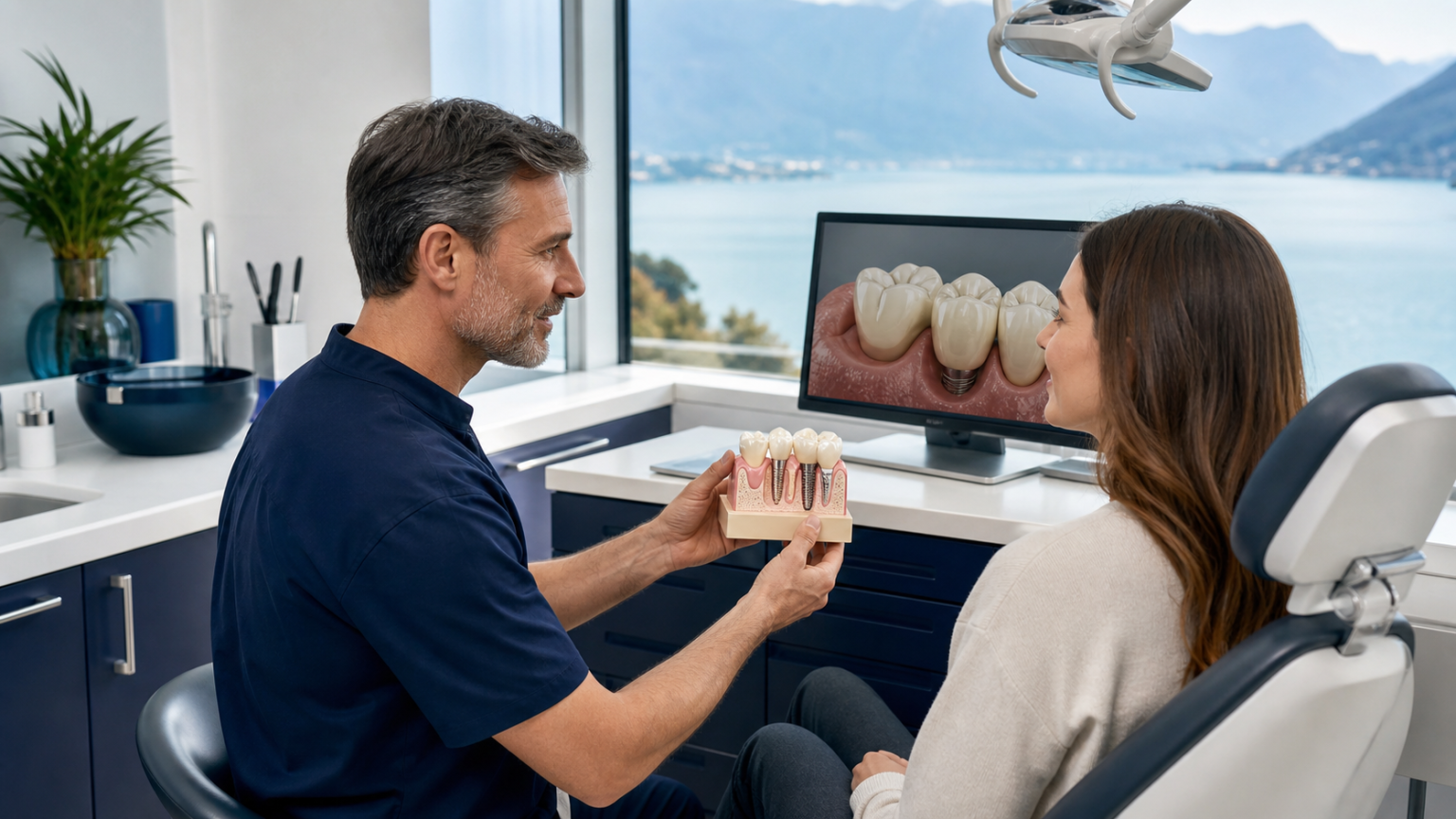
Short answer: In Switzerland, a single dental implant with its final crown often represents a total treatment cost of roughly CHF 2,500 to CHF 5,000. This is an indicative range, not a quote: bone volume, imaging, materials, laboratory work and clinical complexity can change the total considerably.
If you are considering a dental implant in Montreux, the most useful document is a personalised treatment plan prepared after an examination and the necessary X-rays. It should explain the stages, alternatives, expected timing and estimated fees before treatment begins.
A straightforward single-tooth implant treatment commonly includes several separate items:
The CHF 2,500–5,000 range is therefore only a broad orientation. The SSO notes that a full treatment price cannot be determined reliably before the dentist has examined the patient, diagnosed the problem and agreed on a treatment plan.
For private patients, Swiss dental practices use the DENTOTAR® tariff structure. Each listed service is assigned tariff points; the amount in francs is calculated from those points and the practice’s tariff-point value. Material and dental-laboratory costs may appear separately. The estimate should therefore itemise the proposed services instead of presenting only one unexplained total.
DENTOTAR® is the correct current terminology for private dental tariffs in this context. It should not be confused with TARMED, which concerns medical—not private dental—billing.
Usually not, but the answer depends on the cause and legal criteria. According to the Swiss Federal Office of Public Health (FOPH), compulsory health insurance covers dental treatment only in the exhaustively defined situations set out in Articles 17–19a of the Health Care Benefits Ordinance. These include certain serious, unavoidable diseases of the masticatory system, treatment linked to another serious disease, or treatment necessary to manage a serious disease.
Dental treatment following an accident is covered by compulsory health insurance only when no other insurance is responsible. Supplementary dental insurance is contractual: reimbursement limits, waiting periods and exclusions vary. Ask your insurer for written confirmation based on the detailed estimate before treatment.
An implant replaces the missing root without requiring the neighbouring teeth to support the restoration. A bridge may be appropriate when adjacent teeth already need crowns or when implant surgery is unsuitable. Neither option is automatically “better” or cheaper over every time horizon; the right choice depends on oral health, anatomy, maintenance, treatment time and patient priorities.
No. It is a general orientation for a single implant and crown. Only a clinical examination and personalised written estimate can establish the expected total.
No. It is considered only when the available bone is insufficient for the planned implant position and stability.
The team can provide the clinical documents and detailed estimate needed for an insurance request. The insurer alone confirms whether and how much it will reimburse under your policy.
Author: Cabinet Dentaire du Casino team. Medical review: Dr Pedro Elmano Matos, dentist.
Prices and coverage information are indicative and do not replace a personalised treatment plan, written estimate or decision from an insurer.
Call 021 963 36 71, use our appointment form, or review our fees and payment information.